Wednesday, September 19, 2007

George Bernard Shaw's Pygmalion


Read Preface and Acts 1-3 for Monday, Sept. 24th.

Read Acts 4, 5 and the "sequel" for Wednesday, Sept. 26th.

My Fair Lady is based upon this play. Perhaps something to keep in the back of your mind while reading. Especially if you've seen the musical--film version or staged production.

And of course, the Simpsons had their fun with Pygmoelion and their parody of My Fair Lady--My Fair Laddy (see pics).

Have a good weekend.

Quotes and Comments on American Psycho


Here are some quotes from Christian Bale and film maker Mary Harron around the time of American Psycho's film release (in 2000):

From Reel.com:

Q: In a recent Interview magazine you called Patrick Bateman a dweeb. What do you think turns a dweeb into a psychopath, specifically in Patrick's case?

Christian Bale: I have an idea on that, but it has nothing to do with the history of the character or anything like that because I didn't even delve into that. It would have been too realistic an approach to Bateman, who is not a real character. It is not that he is in any way vague or confused at all — he is very sure of his sensibilities about what he likes, why he likes things, what annoys him. To me it is certainty about everything. His obsession with minute details. His certainty that his life is pointless. That drives him crazy because nothing has any meaning and consequently he loses any sort of a conscience and has no limits. He can just as easily shake your hand and smile at you and pay you a compliment or bite your jugular out. He doesn't feel anything and that is his own living hell.


Bateman is unable to relate/connect with human life. It's all surface; not deep. This is why he pays so much attention to his exterior. He does the 1000 crunches and uses the expensive bathing/grooming products and dresses in designer suits. He's a walking advertisement. It's all about brand names and products. It's all about what everyone else is doing. Where is everyone going to eat. What is everybody else listening to. Everyone is going to see Les Mis, so he has to get front row seats. Maybe his 'living hell' is the not being able to feel or care or think for himself.

Q: Mary Harron said in Filmmaker magazine that the movie was realistic up to a point. I would argue that the book is entirely surreal and I just wonder how you saw the film vis-a-vis the book?

Christian Bale: Yes, I do think it is surreal. I think the movie is very surreal as well. We never attempted for realism. I think that Mary is just saying that we weren't going for some sort of cartoonish exaggeration, but there is a heightening to it. That was something that we had to be very careful about, but which didn't become too massive that it was entirely caricature. It had to be somewhat of a parody.


I'm not sure how I feel about Bale's answer. The Huey Lewis scene in the film is a cartoonish (perhaps highly caffeinated performance). They weren't careful in that scene. The parody works when it's not overdone. Look at a scene like the business card scene or even the opening scene with Bateman going through his daily routine. The parody: a day in the life of the yuppie.

From Barnes and Noble.com:

B&N.com: The film's actually very satirical and funny, which is what Ellis claimed the book was all along. Mary downplayed the carnage and sharpened the social satire. It makes you wonder why Ellis needed all that excruciatingly detailed violence in the first place.

Christian Bale: Because he wanted to show that Bateman's obsession with details is the source of his insanity. That's what I see about Bateman -- his fixation on minutiae, and absolutely needing to get an answer for every little tiny thing, even though all the things he's interested in are completely shallow.


I don't think Bateman kills anyone. I don't think any of it is real. He's a cut-throat businessman. He kills Paul Allen, not literally but figuratively. They're all Paul Allens. Kill one and another one will replace him. You noticed how many VP's were at the office he worked at. Each business read: so and so. Vice President.

What do you all think?

Thursday, September 13, 2007

Don't do it! Don't eat that baby!


The overall impression I get from you guys is: why does Swift drop the irony/the sarcasm/the deadpan and get all serious towards the end?

I'm sure this will come up again. Why does the funny stop? In dark comedy and satire, there is a comment being made. It isn't like other forms of comedy where people laugh and laugh and have a good time and someone farts and laughs or trips and falls and hurts themselves and laughs and trips then farts and laughs. Satire and dark comedy is a social critique hidden beneath laughs. Sometimes the critique rears it's ugly serious head for a second. In Dr. Strangelove, it sneaks in. It's a (somewhat) serious moment when all of the planes are called off but one. In Little Murders, it gets serious and not so funny after the death of Patsy. I wonder if the same can be said about Dr. Strangelove and after the death of Ripper. Perhaps something to think about when we watch these films. What happens when a character dies?

Maybe Swift could only do so much with the dead baby thing. Recipes. Check. Skin used for gloves. Check. Hm. He could have gone on to coats or shoes, I suppose.

As the proposal progresses, the audience is desensitized to what is being said. So how shocking it would be to come in with truth of the matter (even if the truth comes off with a snippet of anti-Semitism with his line "Nor acting any longer like the Jews"). The tone shift is abrupt. I don't know what to do with the speaker. Do I trust him? He's persuasive from the get-go, even with the baby eating proposal, but what do I do when he gets 'real'? Again, we should discuss these moments when they come up.

Wednesday, September 12, 2007

Mark Twain Assigned Readings


For next class (Mon. Sept. 17th): Read Twain's The Man that Corrupted Hadleyburg (pages 478-528 in the Signet Classic Book of Mark Twain's Short Stories)

For Wed. Sept. 19th: Read Twain's Extracts from Adam's Diary (pages 379-390 in the Signet), The Notorious Jumping Frog of Calaveras County (pages 3-9), and The Invalid's Story (pages 260-268 in the Signet)

Tuesday, September 11, 2007

The Films


Sept 19th: Monty Python's Life of Brian
Sept 26th: In the Company of Men or Clueless
Oct 3rd: The Discreet Charm of the Bourgeoisie
Oct 10th: Serial Mom or Polyester
Oct 17th: Addams Family Values
Oct 24th: Network
Oct 31st: Bucket of Blood
Nov 7th: Bamboozled or Hollywood Shuffle
Nov 12th: MASH (two signed up for this already)
Nov 26th: Bob Roberts or Bulworth
Nov 28th: Election
Dec 5th: Wag the Dog

Sunday, September 9, 2007

Parody


What is parody? What comes to mind?

For me, it's Saturday Night Live. Or it's Weird Al.

What's the difference between parody and satire? Stephen Geller says satire pokes fun at content, whereas parody pokes fun at style. What does that mean exactly?

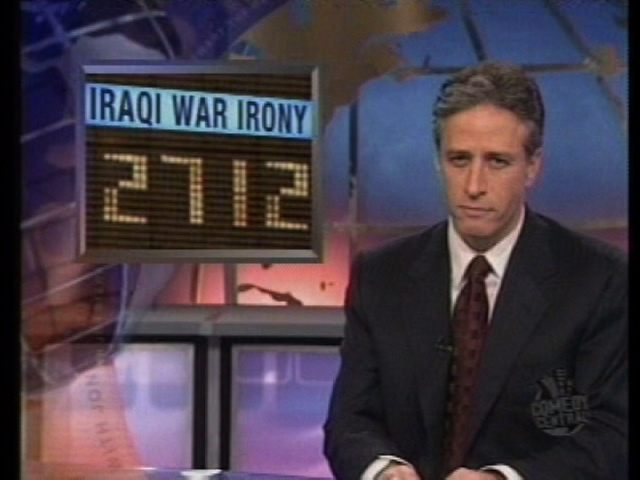
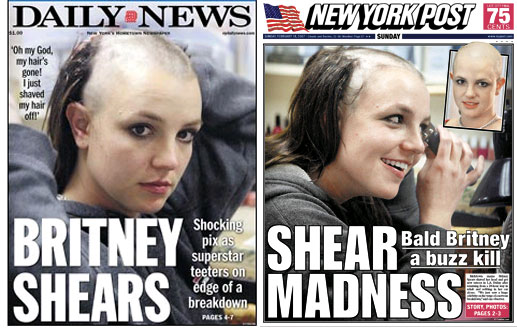
Let's take the Daily Show as an example. The parody in the show is poking fun at the news broadcast (style). The satire in the show is poking fun at the social and political events (content) such as war or Britney Spears' breakdown.

Parody is innocent fun. It's playful. Satire stings a little. This is why the Daily Show works. It's playful, yet it's biting in its social criticism.

Duck and Cover

This was produced in 1951 around the time the Soviet Union started testing their nuclear weapons. The U.S. feared that they had to prepare for the possibility of a nuclear attack. The result was this film which was shown in schools. Could you imagine? We had our fire drills and our tornado drills, but never anything like this. Could you imagine being in a class room having to watch this? A cartoon turtle telling us that nuclear war can happen at any time and without warning. And all you have to do is duck and cover, like that's going to save you from the extreme heat and radiation. My favorite line: Even a newspaper can save you from a bad burn.

I thought I'd share this with you all. Give you an idea of what was happening in the 50's, so that you get a better understanding of the fear and paranoia. And the result of all this, of course, is Kubrick's "Dr. Strangelove".